
X impressions are the total number of times any post yours or someone else’s has appeared on a screen. This includes Timeline views, Search results, Profile visits, and embedded content. Unlike reach (unique viewers), impressions count every display event, making them the single most transparent measure of how far your content travels inside X’s Engagement Velocity algorithm in 2026.
In the current X ecosystem, impressions serve as the foundational input signal that triggers downstream metrics: clicks, replies, reposts, bookmarks, and critically algorithmic amplification. If your impression count is stagnant, every other metric downstream will follow.
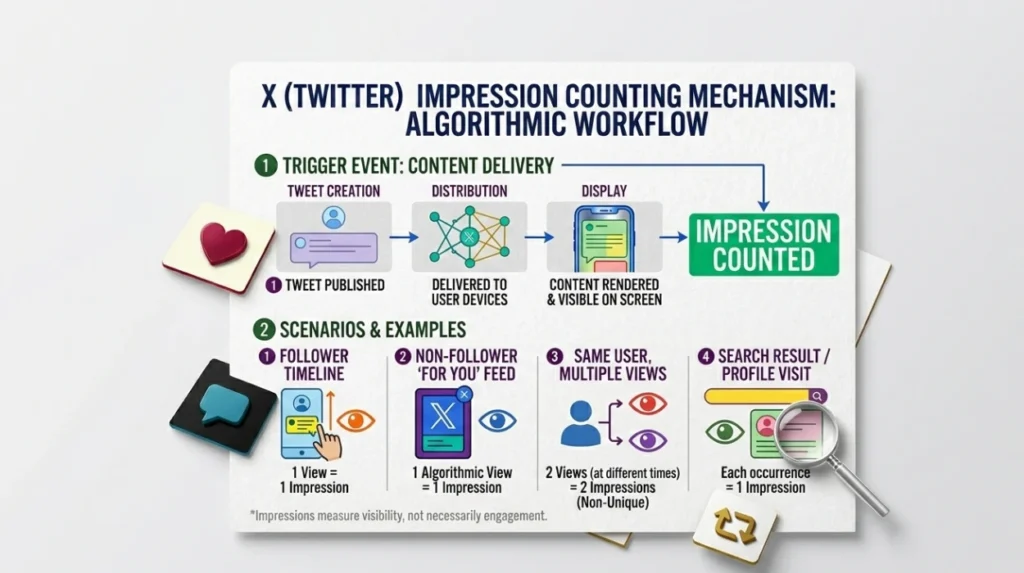
X now operates two primary feed layers: the For You feed (algorithmic) and the Following feed (chronological). The vast majority of impressions studies from X’s own transparency reports suggest over 80% are generated through the For You feed. This means your content’s impression potential is dictated not just by your follower count, but by how the algorithm scores your post in real time.
The algorithm evaluates several 2026-specific signals before deciding whether to amplify a post:
Many marketers conflate impressions with reach. The difference has practical consequences for your content strategy:
For most brand and creator accounts, optimizing for impressions-per-post is the primary lever for growing Profile Credibility over time which in turn unlocks wider distribution for future posts.
X’s ranking model operates on a reinforcing feedback loop. A post that earns strong early impressions is eligible for inclusion in the Explore tab, email digests, and embedded widget placements multiplying its reach exponentially. Conversely, a post that fails to generate sufficient impressions in its first hour is deprioritized and rarely recovers organically.
Understanding this loop reframes how high-performing teams think about content distribution:
For B2B brands and agencies, impressions function as a top-of-funnel awareness KPI. A consistent impression baseline above your industry benchmark correlates with measurable increases in branded search queries, LinkedIn profile visits, and inbound inquiry volume even when click-through rates remain modest.
Key insight: In 2026, X has integrated impression data into its revenue attribution dashboard for verified organizations. This means impressions generated on organic posts can now be attributed to downstream conversion events in X Ads Manager closing the loop between organic visibility and paid ROI.
Impression benchmarks vary significantly by account tier and vertical. As a general 2026 reference:
X’s 2026 algorithm heavily rewards content that holds attention. Posts that generate high Dwell Time signals include:
By contrast, posts that link externally especially to competing platforms are consistently downranked by X’s algorithm, resulting in suppressed impressions regardless of follower count.
Accounts that publish fewer than 3–5 posts per week experience measurable Profile Credibility decay in X’s ranking systems. The algorithm interprets low posting frequency as reduced relevance, which compounds into lower impression allocation per post over time.
Account health factors that suppress impressions include:

X’s Trust & Safety systems apply distribution restrictions to accounts flagged for inauthentic behavior, policy violations, or spam-adjacent patterns. These restrictions directly suppress impressions by limiting For You feed eligibility. Maintaining platform-compliant growth strategies is therefore not just an ethical consideration it is a performance imperative.
The following organic strategies consistently produce above-benchmark impression performance in 2026:
A growing strategic question in the X marketing community involves the role of Accelerated Social Proof early-stage engagement signals used to give new content a measurable head start in the algorithmic ranking window. For a full breakdown, see our analysis: can buying X impressions actually help your content get seen more? which examines the mechanics, risks, and strategic applications in depth.
The core strategic logic is this: because X’s algorithm weights early Engagement Velocity so heavily, posts that receive qualified initial engagement signals are more likely to enter secondary amplification loops. This is why Profile Credibility building through both organic and strategic means is a legitimate component of enterprise-level X content strategy.
X provides native impression data through two primary interfaces:
Impressions alone are insufficient for strategic decision-making. Track these in parallel:
For brands entering X’s ecosystem or relaunching dormant accounts, establishing an impression baseline is the first 90-day objective. Without a credible baseline, content quality alone cannot overcome the algorithmic disadvantage of low Profile Credibility.
A structured baseline strategy typically involves:
X’s algorithm has undergone more significant updates in 2025–2026 than in any comparable two-year period in the platform’s history. Changes to the For You feed weighting formula, the introduction of Dwell Time as a first-class ranking signal, and the expansion of Conversational Context clustering have all materially shifted best practices.
Brands that attempt to apply 2022–2023 X strategies in 2026 consistently underperform relative to their impression potential. Working with practitioners who operate natively within X’s current ecosystem not generic social media frameworks is the clearest differentiator between campaigns that scale and those that stagnate.
Ready to scale your X presence with a data-driven impression strategy? Explore our X Visibility & Profile Credibility Services engineered for the 2026 algorithm and fully platform-compliant.
Any instance of your post appearing on a screen whether in the For You feed, search results, profile visits, or embedded content counts as one impression. Each display event is tracked separately, so one user can generate multiple impressions on the same post.
A sudden drop usually signals one of three things: a posting cadence gap (inactivity triggers Profile Credibility decay), a shift in X’s algorithm weighting, or reduced Engagement Velocity on recent posts. Accounts that fail to generate early interactions within the first 30 minutes are systematically deprioritized.
Yes. X’s Creator Revenue Sharing program uses impression thresholds as a baseline eligibility requirement alongside follower count. Consistently low impressions even with a high follower count can disqualify accounts from ad revenue participation.
he 2026 industry benchmark sits between 1.5% and 3.5%. Anything above 5% indicates strong content-audience resonance and typically triggers Sentiment Cluster inclusion, which amplifies reach further organically.
Significantly. X’s algorithm actively suppresses posts containing outbound links — particularly to competing platforms. Native content (text, video, polls, carousels) consistently outperforms link-based posts by 40–60% on average impression delivery.
Yes, but it requires a deliberate reset strategy: resuming consistent posting cadence, engaging within active Conversational Context threads, and rebuilding Engagement Velocity through high-Dwell-Time content formats. Most accounts see measurable impression recovery within 3–5 weeks of sustained activity.