
X growth strategies differ based on how profiles generate authority, distribute content, and sustain audience engagement across the platform. X audience development methods are evaluated through authority indicators, engagement quality, visibility consistency, audience retention, and long-term profile credibility rather than follower growth alone.
An X authority building strategy for new brands is a structured approach to developing recognised expertise, profile credibility, and consistent visibility within the platform’s information ecosystem. Unlike simple audience acquisition, authority building focuses on establishing a profile as a reliable source of knowledge within a clearly defined topic. X operates by distributing content according to relevance, engagement signals, and interaction quality instead of relying exclusively on account size. This enables newer profiles to compete for visibility when their content consistently satisfies audience intent. Authority therefore represents accumulated evidence of expertise rather than popularity.
An authority strategy combines topical consistency, educational publishing, engagement quality, and community participation into a long-term framework. Every published post contributes additional contextual information that strengthens the platform’s understanding of profile relevance. As these relationships develop, audience recognition and content distribution become increasingly aligned with the selected knowledge area. This process creates sustainable profile authority through repeated informational contribution.
Authority building prioritises credibility, whereas visibility-focused growth prioritises exposure. Although both influence audience development, they operate through different mechanisms and produce different long-term outcomes.
Visibility-focused approaches concentrate on increasing impressions, reach, and short-term engagement. Trending conversations, timely publishing, and high-frequency posting often improve immediate exposure across recommendation systems. These tactics generate broader distribution but do not automatically establish subject expertise. Visibility therefore represents audience exposure without necessarily creating lasting trust.
Authority-building approaches prioritise informational value, topical depth, and consistent expertise. Educational analysis, concept explanation, and knowledge-focused publishing strengthen profile credibility through repeated evidence of subject understanding. Authority grows more gradually than visibility because it depends upon cumulative recognition rather than isolated performance. Over time, authority increases the likelihood that future content receives sustained engagement from relevant audiences.
The comparison highlights different strategic outcomes. Visibility improves discoverability, whereas authority improves recognition. Profiles combining both mechanisms generally maintain stronger long-term audience relationships than those relying exclusively on exposure.
Organic growth strategies develop audiences through consistent publishing and community interaction. Amplification-focused approaches increase distribution by encouraging broader exposure through engagement dynamics and network effects. Both methods contribute to audience growth, yet their effectiveness depends on different platform mechanisms.
Organic growth refers to audience expansion generated through regular publication, educational content, and direct participation in discussions. X distributes organically successful content when users demonstrate sustained interest through replies, reposts, bookmarks, and profile visits. Organic growth strengthens profile credibility because visibility emerges from repeated informational value rather than distribution acceleration.
Organic approaches generally produce stronger audience quality. Users discovering content through topic relevance often demonstrate higher engagement consistency because their interests align with the published subject matter. However, authority accumulation requires ongoing publication across extended periods, making organic development comparatively slower.
Amplification-focused growth increases visibility by encouraging wider content distribution through network interactions. Reposts, discussion chains, community participation, and conversation placement expand exposure beyond existing followers. Network effects increase audience reach as information spreads across interconnected user groups.
Amplification improves growth velocity because distribution extends into multiple audience clusters simultaneously. Nevertheless, broader exposure does not guarantee long-term authority if informational consistency remains limited. Amplification therefore accelerates visibility while authority depends upon subsequent content quality.
Content-led growth prioritises informational quality as the primary driver of visibility. Engagement-led growth prioritises active interaction with existing conversations to increase profile exposure. Both methods strengthen audience development through different behavioural mechanisms.
Content-led growth defines profile identity through educational publishing. Articles, analytical threads, conceptual explanations, and research summaries establish topical expertise. Recommendation systems increasingly associate consistent educational publishing with relevant knowledge areas, strengthening future distribution opportunities. Content therefore functions as the foundation of long-term authority.
Engagement-led growth develops visibility through replies, discussion participation, and conversation expansion. Informative responses position profiles directly within established audience networks. Active engagement improves discoverability because audiences encounter contributions alongside already visible discussions. However, engagement alone creates weaker authority when original content remains limited.
Comparatively, content-led strategies strengthen expertise, whereas engagement-led strategies accelerate discovery. Combining educational publishing with analytical discussion produces stronger authority indicators than relying exclusively on either method.
Audience acquisition focuses on attracting new users, while audience retention concentrates on maintaining ongoing engagement among existing followers. These approaches influence profile growth through different measurements.
Audience acquisition evaluates reach expansion, profile discovery, and new follower generation. Educational content, search relevance, and algorithmic recommendations contribute directly to acquisition by exposing profiles to previously unfamiliar audiences. Distribution efficiency therefore becomes a key performance indicator.
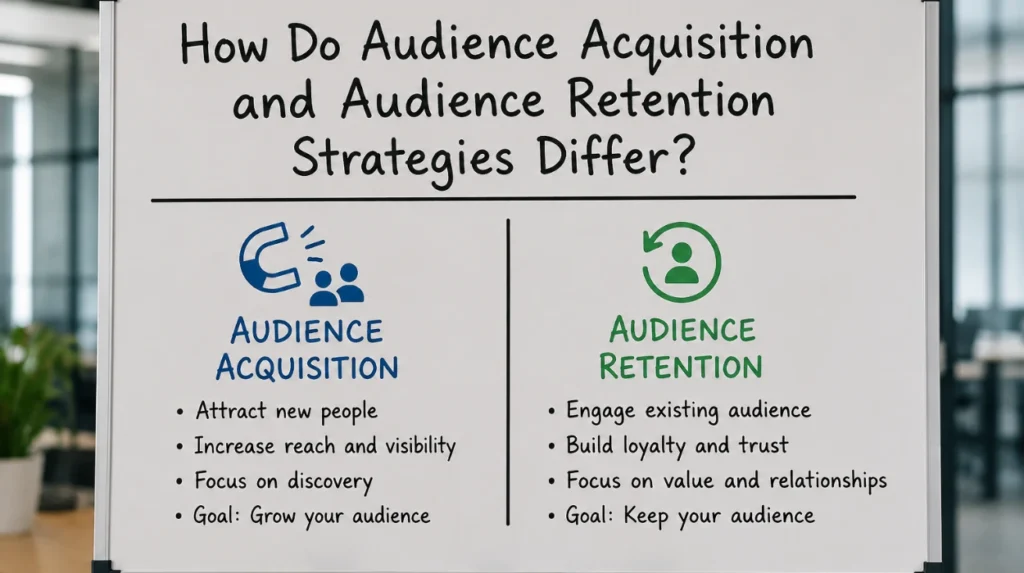
Audience retention evaluates recurring interaction and sustained interest. Returning readers, repeated discussion participation, consistent bookmarking, and ongoing engagement demonstrate successful retention. Retention strengthens authority because familiar audiences increasingly recognise the profile as a dependable information source.
Retention generally contributes more strongly to authority than acquisition alone. A growing audience without recurring engagement produces weaker credibility than a smaller audience consistently interacting with specialised content. Effective authority strategies therefore balance expansion with relationship continuity.
Authority develops through multiple interconnected methods rather than isolated tactics. Different approaches influence scalability, resource requirements, and long-term sustainability.
Maintaining a clearly defined subject focus strengthens semantic associations between published content and profile identity. Consistency enables recommendation systems to classify profiles more accurately within relevant knowledge areas. This improves long-term discoverability while reinforcing audience expectations.
Educational publishing expands authority through concept explanation and analytical evaluation. Users frequently bookmark explanatory content because it remains valuable beyond immediate publication. This behaviour strengthens engagement quality and supports recurring visibility.
Meaningful discussion within specialised conversations expands profile exposure among highly relevant audiences. Informative replies strengthen recognition while increasing opportunities for profile discovery. Community participation therefore supports both authority development and audience expansion.
Original interpretation differentiates profiles within competitive topics. Analytical comparisons, conceptual frameworks, and structured evaluations strengthen expertise because audiences associate originality with deeper understanding. Originality also improves content memorability within recurring discussions.
Thought leadership focuses on expanding knowledge through analysis, education, and interpretation. Promotional content strategies concentrate on increasing awareness of products, services, or announcements. These approaches generate fundamentally different audience responses.
Thought leadership develops authority because informational value remains central to every publication. Explanatory content encourages bookmarking, discussion, and reference sharing, strengthening credibility over time. Recommendation systems also benefit from clearer topical associations when profiles consistently publish educational material.
Promotional content prioritises organisational visibility rather than informational depth. Although promotional publishing generates awareness within existing audiences, it contributes fewer educational signals that reinforce profile expertise. Consequently, engagement quality frequently depends upon existing audience familiarity instead of broader knowledge recognition.
The comparison demonstrates that authority emerges through repeated educational contribution, whereas promotional publishing primarily supports visibility objectives. Profiles seeking long-term expertise therefore rely more heavily on informational publishing.
Short-term visibility measures immediate exposure generated by individual posts or trending discussions. Long-term audience development measures sustained engagement, recurring recognition, and cumulative authority. These approaches produce different growth trajectories.
Short-term visibility increases rapidly through topical relevance, trending participation, and network amplification. Profiles receive immediate exposure when engagement signals exceed distribution thresholds. However, temporary visibility often declines once conversation momentum decreases.
Long-term audience development accumulates through consistent educational publishing, topical clarity, and recurring engagement. Every interaction reinforces existing authority indicators while improving profile familiarity among specialised communities. This cumulative process produces stronger audience trust and more predictable distribution over time.
Evaluating sustainability demonstrates that authority-oriented development maintains greater long-term value. Visibility generates discovery opportunities, whereas authority transforms discovery into recurring audience relationships.
Authority building requires measurable indicators that extend beyond follower count. The following framework compares long-term authority development more accurately.
These measurements provide broader insight into profile authority because they examine credibility, recognition, and sustained audience relationships rather than temporary popularity metrics.
Within broader authority evaluation, organisations frequently examine structured approaches associated with X brand authority building service as a conceptual benchmark for comparing long-term authority frameworks against purely visibility-driven tactics.
X authority building strategies differ from visibility-focused approaches by prioritising expertise, topical consistency, and audience trust over immediate exposure. Organic growth strengthens credibility through educational publishing, while amplification increases distribution through network effects. Content-led approaches establish durable authority, whereas engagement-led methods improve discoverability through active participation. Audience retention reinforces long-term profile recognition more effectively than acquisition alone, and thought leadership contributes stronger credibility than promotional publishing. Evaluating authority through engagement quality, content distribution efficiency, topical relevance, and recurring audience interaction provides a more complete understanding of sustainable profile development.