
Thought leadership content strategy for X is a structured approach to building profile authority through expertise-driven content that consistently generates meaningful engagement, trust, and audience recognition. It differs from promotional publishing because it prioritises knowledge distribution, discussion quality, and long-term credibility over immediate visibility.
X growth strategies differ based on how content generates engagement signals, authority indicators, and network effects. X audience development methods are evaluated through audience growth velocity, engagement quality, profile visibility, and long-term content distribution efficiency.
Thought leadership content strategy focuses on expertise distribution, while promotional content focuses on product, service, or brand visibility. The distinction influences how the X recommendation system interprets engagement patterns and how audiences perceive profile authority over time.
Thought leadership content is educational, analytical, or opinion-led material that demonstrates subject expertise. It operates by introducing perspectives, explaining industry developments, analysing trends, and encouraging meaningful discussion. Promotional content operates by directing attention towards offers, announcements, or commercial objectives. Although both formats contribute to profile activity, they generate different engagement signals and attract different audience behaviours.
Thought leadership generally produces stronger engagement quality because discussions, reposts with commentary, and extended conversations indicate higher audience involvement. Promotional content often generates shorter interaction cycles that rely on existing audience familiarity rather than wider topic relevance. As a result, thought leadership contributes more effectively to sustained profile authority.
The limitation of thought leadership lies in slower audience growth velocity during the early stages. Expertise requires consistency before authority indicators strengthen. Promotional publishing can generate immediate impressions when announcements attract attention, but visibility often declines rapidly without continuous engagement.
X distributes content by evaluating behavioural engagement signals rather than simply prioritising follower relationships. Distribution efficiency depends on interaction quality, topical relevance, conversation depth, and ongoing engagement velocity.
The recommendation system analyses early interactions to determine whether content deserves broader distribution. Replies containing meaningful discussion, reposts with commentary, profile visits, saves, and prolonged reading behaviour all strengthen visibility indicators. Simple reactions contribute less than interactions demonstrating active audience participation.
Thought leadership content operates effectively because educational posts frequently encourage interpretation, debate, and follow-up discussion. Longer engagement sessions provide stronger behavioural evidence that the content satisfies audience interest. This increases opportunities for distribution beyond existing followers.
Promotional publishing often depends on audiences already familiar with the profile. Without sustained interaction, recommendation signals weaken quickly, limiting content amplification. Distribution therefore becomes increasingly dependent on follower size rather than content relevance.
Organic growth strategies prioritise sustainable audience development through consistent expertise, while amplification-focused approaches prioritise expanding immediate visibility through increased content exposure.
Organic growth operates by publishing valuable content that gradually strengthens authority indicators. Every meaningful interaction contributes to audience trust, profile recognition, and engagement quality. This process develops stable network effects because audiences repeatedly encounter valuable information within the same expertise area.
Amplification-focused approaches operate by increasing content exposure during initial publication periods. Distribution expands rapidly when early engagement velocity increases. Greater visibility can accelerate audience acquisition, although long-term retention depends on content quality rather than exposure alone.
Organic growth demonstrates stronger sustainability because audience relationships develop through repeated educational interactions. Amplification strategies scale faster during campaigns but require continuous activity to maintain visibility. Without ongoing engagement quality, increased impressions rarely convert into lasting audience development.
The comparison highlights different resource requirements. Organic growth requires consistent content production and subject expertise, whereas amplification demands continual optimisation of distribution timing, engagement stimulation, and content promotion.
Content-led growth builds audiences through information value, while engagement-led growth expands visibility through active participation in conversations across the platform.
Content-led growth operates by publishing original analysis, educational threads, industry commentary, and structured insights. High-value content becomes a recurring reason for audiences to revisit a profile. Authority develops because knowledge remains consistently associated with the creator.
Engagement-led growth operates by replying to discussions, participating in trending conversations, asking questions, and maintaining visible interactions with relevant communities. Instead of relying solely on published posts, visibility expands through continuous participation across multiple discussion networks.
Content-led growth strengthens profile authority more efficiently because audiences associate expertise with original contributions. Engagement-led growth increases discovery opportunities by exposing profiles to wider conversation groups. Combining both mechanisms often improves content distribution efficiency because engagement creates visibility while original content reinforces credibility.
The limitation of engagement-led growth appears when interaction lacks topical consistency. High reply activity without subject expertise weakens authority indicators because audience expectations become fragmented. Content-led strategies avoid this limitation through focused thematic publishing.
Audience acquisition strategies prioritise attracting new followers, while audience retention strategies strengthen ongoing relationships with existing audiences through consistent value delivery.
Audience acquisition operates by increasing discoverability. Profiles expand reach through searchable discussions, educational threads, topical commentary, and participation in active conversations. Visibility indicators become the primary measurement because exposure precedes audience growth.
Audience retention operates by maintaining publishing consistency, thematic relevance, and engagement quality. Existing followers continue interacting because expectations remain aligned with profile expertise. Retention strengthens long-term authority since recurring engagement demonstrates audience satisfaction.
Acquisition produces measurable audience growth velocity but introduces variability in audience quality. Retention develops stronger engagement consistency because established followers interact repeatedly across multiple publications. Sustainable profile growth depends on balancing both objectives rather than maximising only follower numbers.
Retention strategies also improve content amplification indirectly. Existing audiences frequently provide early engagement signals, increasing opportunities for algorithmic distribution beyond the immediate follower base.
Authority-building methods develop expertise recognition, whereas visibility-focused tactics maximise profile exposure through increased publishing activity and engagement frequency.
Authority-building operates by maintaining topical consistency, publishing evidence-based analysis, explaining complex concepts, and contributing valuable perspectives. Authority indicators accumulate over extended periods because audiences repeatedly recognise expertise within a defined subject area.
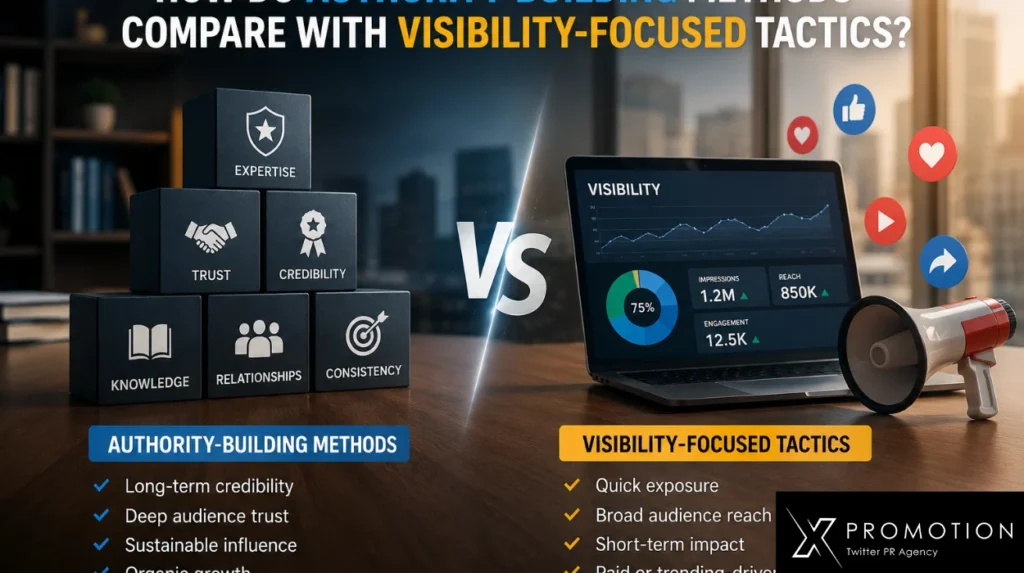
Visibility-focused tactics operate through publication frequency, timely participation in trending discussions, concise content formats, and immediate interaction with ongoing conversations. These mechanisms increase exposure but do not automatically establish subject credibility.
Authority demonstrates greater sustainability because expertise continues generating engagement beyond publication dates. Visibility produces faster discovery opportunities but often depends on continuous activity. Profiles relying exclusively on visibility tactics experience fluctuating reach because engagement patterns remain event-driven rather than expertise-driven.
The comparison demonstrates different strategic objectives. Authority strengthens trust and engagement quality, while visibility expands audience reach. Sustainable growth depends on integrating both mechanisms without allowing visibility to dilute topical expertise.
Engagement signals determine whether educational content reaches broader audiences by measuring interaction quality rather than simple activity volume.
Engagement signals include replies that extend discussions, reposts with original commentary, profile visits, dwell time, bookmarking behaviour, and conversation continuity. Each interaction demonstrates audience investment beyond passive consumption.
Thought leadership content naturally generates stronger engagement quality because analytical publishing encourages interpretation, disagreement, clarification, and additional questions. These behavioural patterns strengthen recommendation confidence, leading to broader distribution.
Surface-level interactions generate weaker authority indicators because they demonstrate limited audience investment. Profiles generating meaningful discussion consistently achieve stronger visibility indicators than profiles relying exclusively on reaction-based engagement.
Evaluating engagement quality therefore provides a more accurate measurement of profile performance than measuring total interactions alone.
Long-term audience development depends on combining authority-building, content consistency, engagement quality, and sustainable audience retention rather than pursuing isolated visibility gains.
Short-term visibility strategies increase exposure efficiently when engagement velocity accelerates rapidly after publication. These strategies support discovery but require continual optimisation to maintain performance. Distribution declines once engagement momentum decreases.
Long-term development operates through recurring expertise demonstration, predictable publishing themes, ongoing audience interaction, and stable authority indicators. The audience increasingly associates the profile with a specialised knowledge area, improving recognition and engagement consistency.
Comparing both approaches demonstrates that visibility accelerates discovery, whereas authority strengthens retention. Sustainable audience development emerges when educational publishing, meaningful engagement, and consistent topical expertise reinforce one another over extended publishing cycles.
When evaluating competing approaches, consider these measurable dimensions:
These measurements provide a balanced assessment because they evaluate sustainable authority alongside immediate visibility performance.
Thought leadership content strategy for X differs from promotional publishing because it builds authority through expertise rather than commercial messaging. Organic growth strategies strengthen sustainable profile authority, while amplification-focused approaches increase immediate visibility. Content-led growth reinforces expertise, whereas engagement-led growth expands discovery through conversation participation. Audience acquisition increases reach, while audience retention strengthens engagement quality and long-term network effects.
Authority-building methods deliver stronger sustainability because they establish lasting audience trust through consistent knowledge sharing. Visibility-focused tactics improve exposure but require continuous optimisation to maintain distribution. Effective thought leadership therefore depends on balancing authority indicators, engagement signals, audience retention, and content distribution efficiency rather than relying on a single growth mechanism.
Within this evaluation, profiles seeking stronger authority often connect broader strategic planning with structured frameworks such as X PR thought leadership content package, allowing analysis of how long-term expertise development differs from isolated visibility initiatives.