
Brand values communication strategy for X is the structured process of expressing an organisation’s principles through consistent content, interactions, and participation across the X ecosystem. Its effectiveness is evaluated through engagement quality, profile authority, content distribution efficiency, audience trust, and long-term visibility rather than isolated engagement metrics.
X growth strategies differ based on how content generates engagement signals, builds profile authority, and strengthens audience relationships over time. X audience development methods are evaluated through audience growth velocity, content amplification efficiency, authority indicators, engagement quality, and sustainable visibility across the platform.
A brand values communication strategy for X is a framework that translates organisational principles into consistent public communication. It operates by aligning content themes, conversation patterns, audience interactions, and publishing behaviour with clearly defined values that remain stable across different topics. Unlike campaign-focused communication, this approach prioritises long-term consistency over isolated promotional activity. The strategy influences both human perception and platform interpretation because repeated topical consistency contributes to stronger authority signals. Within the X ecosystem, profile identity develops through accumulated behavioural patterns rather than individual posts. This creates a measurable relationship between communication consistency and audience recognition.
The mechanism operates through repeated semantic associations between topics, viewpoints, and engagement behaviour. Every published thread, reply, discussion, and opinion contributes additional contextual information that strengthens topical relevance. X distributes content by analysing interaction behaviour, engagement velocity, topical relationships, and audience response patterns. Consistent value-driven communication improves contextual clarity, allowing audiences to associate the profile with specific expertise rather than disconnected content categories. Profile authority therefore develops from cumulative semantic consistency instead of isolated visibility spikes.
A communication strategy centred on brand values differs from promotional messaging because it focuses on principles before products. Promotional content aims to increase immediate awareness, while values-based communication establishes long-term recognition through repeated conceptual alignment. This distinction affects audience expectations and engagement quality. Profiles associated with consistent viewpoints generate stronger trust indicators because audiences recognise predictable thematic patterns. As a result, audience retention frequently improves alongside profile credibility.
Organic growth is audience expansion generated through content relevance, audience interaction, topical authority, and sustained engagement behaviour. Amplification-focused approaches increase visibility by accelerating content exposure through coordinated distribution mechanisms and broader audience reach. Both approaches influence profile growth, but they operate through different visibility systems within X.
Organic growth operates by strengthening engagement signals over extended periods. High-quality discussions, consistent publishing frequency, informative threads, meaningful replies, and topical expertise collectively improve distribution efficiency. X identifies positive engagement behaviour through replies, reposts, profile visits, bookmarks, and sustained reading behaviour. These interactions contribute to stronger visibility indicators because the platform recognises continuous audience interest rather than temporary attention.
Amplification-focused approaches prioritise rapid exposure. Content receives broader initial distribution through expanded network participation, coordinated sharing behaviour, increased interaction velocity, or external audience referral. Higher exposure creates additional engagement opportunities, but amplification alone does not establish profile authority. If audience response weakens after expanded distribution, visibility decreases because engagement quality remains the dominant evaluation factor.
Organic strategies generally demonstrate stronger sustainability because authority accumulates gradually through consistent audience recognition. Amplification-focused approaches produce faster visibility gains but require continuous distribution support to maintain reach. Resource requirements also differ significantly. Organic development depends primarily on editorial consistency and topical expertise, whereas amplification strategies require broader coordination, larger publishing systems, or established distribution networks.
Content-led growth is an audience development model driven by valuable information, educational resources, analysis, and topical expertise. Engagement-led growth operates through conversations, replies, discussions, and continuous interaction with existing communities. Both strategies influence visibility differently because X evaluates original content and conversational participation using complementary engagement signals.
Content-led growth develops authority by expanding topical coverage. Educational threads, analytical posts, research summaries, visual explanations, and structured discussions increase semantic depth across a profile. This improves content distribution because X recognises repeated expertise within specific knowledge domains. Profiles publishing comprehensive information often experience stronger long-term discoverability through recurring topical associations.
Engagement-led growth strengthens network effects through continuous participation. Replies contribute additional visibility because conversations remain visible across multiple audience segments. Active participation increases profile exposure without requiring continuous publication of original long-form content. Audience relationships also develop more rapidly because repeated interactions establish familiarity and responsiveness.
The comparative effectiveness depends on strategic objectives. Content-led growth strengthens profile authority, while engagement-led growth accelerates relationship development. Content production demands greater editorial resources, research, and planning. Engagement-led strategies require sustained participation, monitoring, and rapid response cycles. Profiles combining both mechanisms frequently achieve balanced audience growth because informative content attracts attention while meaningful interaction strengthens audience retention.
Audience acquisition is the process of expanding profile reach by attracting new followers through discoverability, topical relevance, and visibility optimisation. Audience retention focuses on maintaining existing audience interest through consistent communication, reliable publishing behaviour, and recurring value delivery. These strategies influence different stages of audience development.
Acquisition strategies operate through visibility indicators. High-performing threads, searchable topics, trending discussions, and consistent topical relevance expose profiles to audiences beyond existing followers. X distributes content to broader networks when engagement signals demonstrate increasing audience interest. Acquisition therefore depends heavily on content distribution efficiency and interaction velocity during the early visibility phase.
Retention strategies operate through audience expectation. Consistent publishing themes, recognisable communication patterns, and stable content quality encourage repeated engagement. Returning audiences contribute stronger engagement quality because existing followers interact more frequently through replies, reposts, profile visits, and discussions. These repeated behaviours strengthen authority indicators by demonstrating sustained audience interest.
Acquisition expands audience size, while retention strengthens audience quality. Growth without retention creates unstable visibility because engagement decreases after initial discovery. Retention without acquisition limits long-term expansion because audience size remains static. Sustainable profile development requires continuous balance between discovery mechanisms and audience relationship maintenance.
Authority-building methods establish recognised expertise through consistent knowledge demonstration, topical depth, and semantic consistency. Visibility-focused tactics prioritise exposure through publication frequency, trend participation, and broader distribution opportunities. Both influence profile performance, yet they generate different long-term outcomes.
Authority develops through accumulated expertise. X associates repeated subject coverage with stronger topical relevance, allowing profiles to develop identifiable knowledge domains. Educational content, analytical commentary, consistent terminology, and thematic continuity strengthen authority indicators over time. Audience trust also increases because communication patterns remain predictable and informative.
Visibility-focused tactics operate through exposure frequency. Trending conversations, timely participation, active discussion, and publication consistency maximise audience reach. Higher visibility increases discovery opportunities but does not automatically strengthen credibility. Audiences evaluate expertise independently after initial exposure. Consequently, visibility without authority frequently produces inconsistent engagement quality.
Authority-building demonstrates stronger sustainability because recognition accumulates through repeated evidence of expertise. Visibility-focused tactics provide immediate audience reach but require continuous activity to maintain exposure. Resource allocation also differs. Authority depends on research quality and editorial planning, while visibility relies on publishing responsiveness and continuous platform participation.
Thought leadership is the consistent publication of original analysis, informed perspectives, evidence-based interpretation, and topical expertise. Promotional content strategies focus on increasing awareness of products, services, announcements, or organisational achievements. Although both influence audience behaviour, they generate different authority signals within X.
Thought leadership operates by contributing new understanding to existing discussions. Analytical threads, research interpretation, industry commentary, and informed perspectives encourage replies, reposts, and extended discussions. These interactions produce stronger engagement quality because audiences participate intellectually rather than react briefly to promotional information. X recognises sustained discussion as a positive engagement signal, increasing content distribution opportunities.
Promotional content operates by communicating organisational updates or marketing objectives. Promotional posts frequently generate short interaction cycles because audience attention centres on announcements rather than ongoing discussion. Visibility therefore depends more heavily on existing audience interest and distribution support. Engagement quality often decreases when promotional frequency exceeds informational content because conversational participation becomes limited.
Thought leadership generally produces stronger profile authority because expertise remains transferable across multiple topics within a knowledge domain. Promotional communication supports awareness objectives but contributes less semantic depth to profile identity. Resource requirements also differ. Thought leadership demands continuous research and analysis, whereas promotional strategies primarily depend on communication planning and campaign scheduling.
Short-term visibility gains focus on immediate exposure generated through timely participation, high-engagement discussions, and accelerated content distribution. Long-term audience development strengthens profile authority through consistent topical relevance, recurring audience engagement, and sustained communication quality. Both contribute to growth, but they operate across different performance timelines.
Short-term visibility operates through engagement velocity. Rapid interaction during early distribution increases exposure because X expands content reach when audience response develops quickly. Trending discussions, topical relevance, and immediate participation strengthen initial visibility indicators. However, these gains often decline once engagement velocity decreases.
Long-term audience development operates through accumulated authority signals. Profiles consistently publishing within defined topical areas develop stronger semantic relationships between expertise and audience expectations. Returning followers strengthen engagement quality through repeated interaction, while consistent communication improves trust indicators. These cumulative behaviours create more stable visibility because distribution increasingly reflects established profile authority.
The scalability of long-term development exceeds temporary visibility gains because authority compounds over time. Short-term exposure depends on continuous participation in high-visibility discussions, while long-term development benefits from accumulated expertise and established audience relationships. Sustainable profile growth therefore emerges from repeated authority building rather than isolated viral performance.
X distributes content through behavioural evaluation rather than chronological publication alone. Distribution analyses engagement velocity, interaction diversity, topical relevance, audience relationships, and profile authority to determine visibility across different audience segments. This creates a dynamic distribution system where content performance influences future exposure.
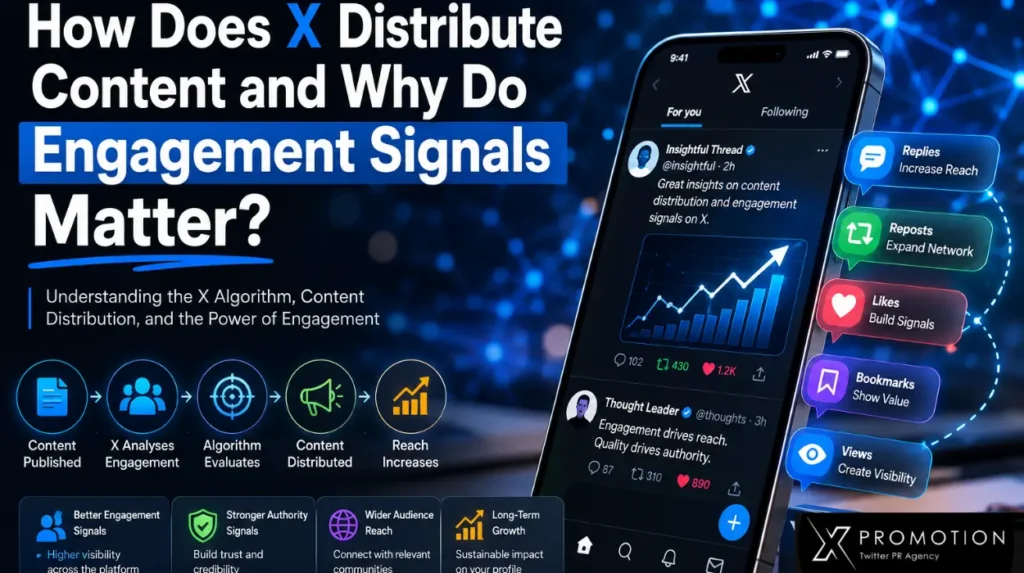
Engagement signals measure audience interaction quality rather than simple activity volume. Replies demonstrate discussion depth, reposts increase network expansion, bookmarks indicate informational value, profile visits strengthen authority evaluation, and sustained reading behaviour reflects content relevance. Combined engagement patterns provide stronger visibility indicators than isolated metrics because they represent multiple forms of audience interest.
Authority indicators further influence distribution by providing contextual confidence about profile expertise. Consistent topical publication, repeated audience interaction, semantic relevance, and sustained engagement history strengthen profile credibility within specific subject areas. X therefore evaluates both immediate engagement behaviour and historical profile performance when expanding content distribution. Profiles demonstrating stable authority frequently achieve more predictable visibility because accumulated expertise reinforces future content performance.
Evaluating a brand values communication strategy requires measurable performance indicators rather than isolated engagement statistics. Multiple dimensions collectively explain communication effectiveness across audience development, authority formation, and content distribution.
Key evaluation factors include:
These indicators collectively provide a balanced assessment because no individual metric fully explains communication performance. High reach without authority limits audience retention, while strong authority without distribution restricts discoverability. Effective evaluation therefore combines visibility indicators, engagement quality, audience development, and topical consistency into a unified analytical framework.
A brand values communication strategy for X develops profile identity through consistent topical communication, repeated authority signals, and sustained audience interaction rather than isolated promotional activity. Organic growth and amplification-focused approaches differ primarily in sustainability and visibility speed, while content-led and engagement-led growth influence authority formation and relationship development through complementary mechanisms.
Audience acquisition expands profile reach, whereas audience retention strengthens engagement quality and long-term visibility. Authority-building methods produce durable recognition through semantic consistency, while visibility-focused tactics maximise immediate exposure through continuous activity. Thought leadership contributes stronger expertise signals than promotional communication because analytical content encourages deeper audience participation and broader contextual relevance.
Evaluating these approaches requires analysis of engagement quality, content distribution efficiency, audience growth velocity, profile authority, scalability, and resource requirements. Together, these factors explain how communication strategies influence sustainable visibility and audience development within the evolving X ecosystem.