
X growth strategies differ based on the deployment of verification signals, algorithmic amplification vectors, and the deliberate structuring of profile authority. An executive PR strategy on the platform requires an objective evaluation of how paid verification architecture alters content distribution efficiency and network trust dynamics compared to legacy organic positioning.
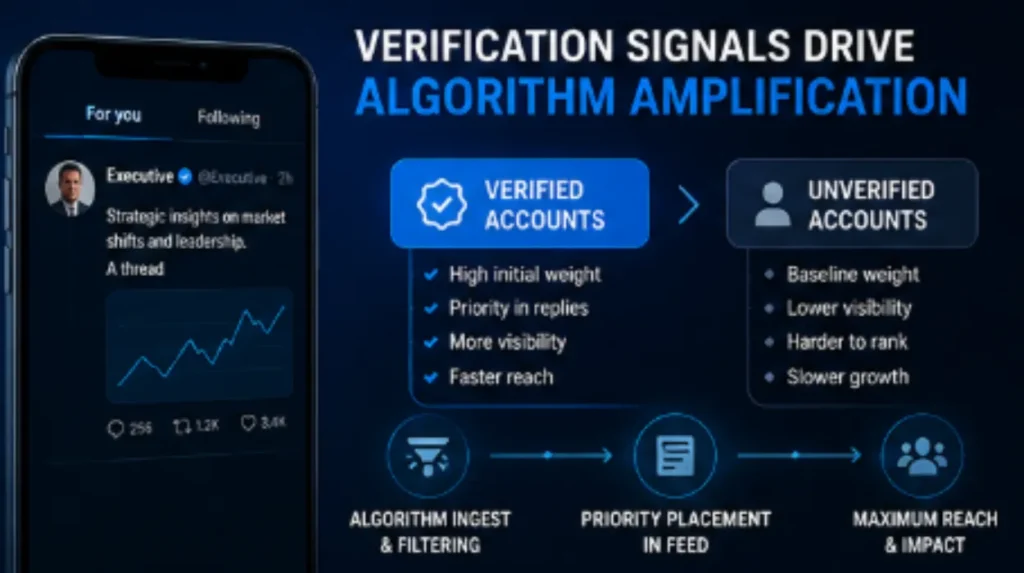
Verification signals fundamentally change the baseline visibility indicators within the X recommendation engine. The platform operates a two-tiered distribution matrix where verified profiles receive explicit algorithmic weighting in the For You feed, reply networks, and search results. This mechanism prioritises content based on account status, shifting the distribution landscape from a pure engagement-led model to a structural-priority model.
The primary mechanism governing this amplification is the priority reply sorting algorithm. When an executive profile interacts with high-authority nodes, the verification signal places their input at the apex of the comment architecture. This structural positioning accelerates audience growth velocity by capturing passive impressions from established dialogue threads, bypassing the traditional latency associated with organic discovery.
However, verification alone does not guarantee sustained engagement quality. While the visibility footprint expands linearly with account status, the actual transformation of impressions into profile authority depends entirely on the substance of the ideas presented. The limitation of relying solely on verification infrastructure lies in its binary nature; it lowers the barrier to initial visibility but increases scrutiny on the actual message.
Organic growth strategies focus on the compounding returns of native network effects, where audience acquisition occurs through voluntary peer-to-peer distribution. Amplification-focused approaches leverage paid infrastructure, including verification and targeted content distribution, to force visibility into specific algorithmic verticals.
| Evaluation Dimension | Organic Growth Strategies | Amplification-Focused Approaches |
| Primary Mechanism | Peer-to-peer sharing and organic quote-posting | Algorithmic prioritization and paid network distribution |
| Audience Retention | High affinity, low churn, strong relational depth | Variable affinity, potential for high initial audience churn |
| Velocity | Linear, highly dependent on sustained engagement signals | Exponential, driven by structural account status overrides |
| Resource Allocation | Intensive time investment in direct community building | Capital deployment for verification and strategic PR alignment |
| Scalability | Latent, bottlenecked by creator bandwidth limitations | High, detached from immediate manual networking constraints |
The core benefit of the organic method resides in the high fidelity of the audience reach. Users who find an executive profile through non-promoted thought leadership signals exhibit stronger brand alignment and long-term retention. The limitation is the speed of acquisition; without verification hooks, the profile remains vulnerable to algorithmic suppression phases where unverified content is suppressed to favor monetised accounts.
Conversely, amplification-focused models achieve immediate scale but require systematic maintenance to prevent audience dilution. When a profile uses an executive X premium PR strategy to gain visibility, the initial influx of attention consists of low-affinity users. Sustaining this network footprint requires transitioning these cold impressions into high-value professional relationships through disciplined, analytical insight generation.
Content-led growth operates by publishing standalone, high-density analytical assets such as long-form articles, white papers, and data-driven graphics directly onto the timeline. Engagement-led growth relies on the continuous optimization of interpersonal feedback loops, using conversational replies, tag networks, and live event commentaries to maintain high visibility indicators.
Content-led growth utilizes the X platform as a primary publishing house. The executive establishes profile authority by outputting primary insights that serve as reference points for other industry participants. This approach triggers deliberate bookmarking and deliberate sharing actions, which the X algorithm weights heavily as deep engagement signals, directly expanding the profile’s reach into external professional networks.
Engagement-led systems prioritize the conversational layer of the platform. Instead of creating new long-form assets, the executive injects their perspective into pre-existing viral narratives and industry debates. This method exploits the platform’s recency bias and current trend vectors, ensuring the profile remains visible within active, high-volume search parameters and notification feeds.
Content-Led Growth Matrix:
[Primary Data/Insight Asset] ──> [Bookmarking Signals] ──> [External Network Reach] ──> [Authority Building]

Engagement-Led Growth Matrix:
[Trending Industry Debate] ──> [Priority Replies] ──> [High Notification Volume] ──> [Short-Term Visibility]
The primary divergence between these frameworks appears in the structure of the resulting network. Content-led methods construct a highly professional, low-velocity audience that views the executive as a definitive industry resource. Engagement-led strategies build rapid visibility and high transaction volumes, but often fail to establish deep thought leadership signals, as the profile’s presence is tied to transient platform trends rather than foundational insights.

Audience acquisition models analyze the entry vectors through which new users discover an executive profile. This mechanism relies on maximizing outward-facing visibility indicators, such as appearing in the algorithmic “For You” recommendations, participating in high-exposure spaces, and securing distribution through external digital PR systems. The target metric is the absolute expansion rate of the follower base.
Audience retention, by contrast, evaluates the internal structural integrity of the profile’s network. This process is governed by the consistency of content distribution efficiency and the alignment of subsequent outputs with the expectations established during the acquisition phase. Retention requires an executive to maintain a predictable standard of specialized discourse to prevent unfollow actions and muted notifications.
A common failure in executive positioning is the over-allocation of resources toward acquisition vectors while neglecting retention frameworks. A profile may gain significant numbers of followers through a highly amplified PR campaign or a viral contrarian statement, but if the subsequent content delivery lacks depth, the audience retention rate decays. Long-term audience development demands that acquisition mechanisms are balanced by systematic information delivery that reinforces professional trust.
Authority-building methods prioritize the cultivation of professional credibility and institutional trust over raw numerical reach. These tactics involve the systematic deployment of precise industry nomenclature, case analysis, and long-term trend forecasting. The ultimate goal is to convert the profile into a definitive source of truth within a specific economic or technological sector.
Visibility-focused tactics prioritize impression volume, total engagement counts, and absolute platform reach. These methods utilize engineered hooks, simplified messaging, and participation in broad algorithmic trends to maximize the likelihood of content entering wide distribution loops.
While visibility tactics generate immediate psychological proof through large public metrics, they often dilute the executive’s professional standing. High impression counts generated via generalized topics do not translate into executive influence. True authority building operates on smaller, high-value cohorts where the density of the information matters more than the scale of distribution, rendering it the more sustainable approach for corporate governance and corporate communication objectives.
Long-form thought leadership formats allow executives to bypass the historical constraints of short-form microblogging by publishing complete analyses directly to the platform. This approach uses the expanded real estate of premium verification to build out detailed industry critiques. The strength of this model lies in its ability to satisfy the informational needs of sophisticated stakeholders, institutional investors, and trade media representatives.
The primary limitation of long-form thought leadership is its high demand on executive bandwidth and cognitive resources. Producing rigorous, data-backed analysis requires significant research and clear structural execution. Furthermore, the platform’s audience often exhibits short attention spans, meaning long-form posts require strategic visual structuring and clear structural formatting to capture and hold attention within a fast-moving timeline.
Long-Form Thought Leadership:
[High Bandwidth Investment] ──> [Deep Stakeholder Trust] ──> [Persistent Professional Influence]

Short-Term Promotional Content:
[Low Capital/Time Investment] ──> [Immediate Spikes in Visibility] ──> [Rapid Decay in Relevance]
Short-term promotional content requires much lower resource investment but suffers from rapid decay. Posts designed to highlight specific achievements, corporate milestones, or external media appearances create brief spikes in visibility but fail to stimulate ongoing intellectual engagement. Over-indexing on promotional content signals a self-centric profile architecture, which reduces overall network trust and alienates sophisticated industry peers.
The integration of X infrastructure into broader digital PR systems relies on the platform’s role as a real-time news source for journalists, analysts, and policy makers. When an executive profile achieves verified status and demonstrates high profile authority, its outputs frequently act as primary sources for secondary media coverage. The platform acts as a catalyst for broader corporate narrative distribution.
This distribution operates through systematic content amplification across traditional and digital media barriers. A verified executive post containing definitive commentary on market shifts is regularly cited in mainstream financial media, tech publications, and sector-specific white papers. The network effect initiated on the platform extends into global information distribution systems, increasing the executive’s visibility far beyond the platform’s native interface.
To maximize this efficiency, executives must align their platform activity with comprehensive corporate communication objectives. This alignment requires transitioning away from casual platform usage toward a disciplined model of corporate commentary. By viewing the verified profile as a real-time press office, organizations can manage public perception, navigate industry crises, and position their leadership at the center of critical market dialogues.
When selecting an infrastructure framework to support these outcomes, organizations must evaluate the operational mechanics of comprehensive executive X Premium PR management platforms to ensure consistent narrative execution and risk mitigation across all digital touchpoints.
The evaluation of X growth strategies demonstrates that sustained executive authority requires a calculated balance between verification-driven algorithmic amplification and the delivery of high-density content. While verification provides the structural priority necessary to navigate a crowded recommendation engine, it is the strategic choice between content-led authority building and disciplined audience retention models that dictates long-term communication success. Executives must avoid the pitfalls of short-term visibility tactics, focusing instead on frameworks that convert raw impression volume into enduring professional trust and broader digital PR leverage.