
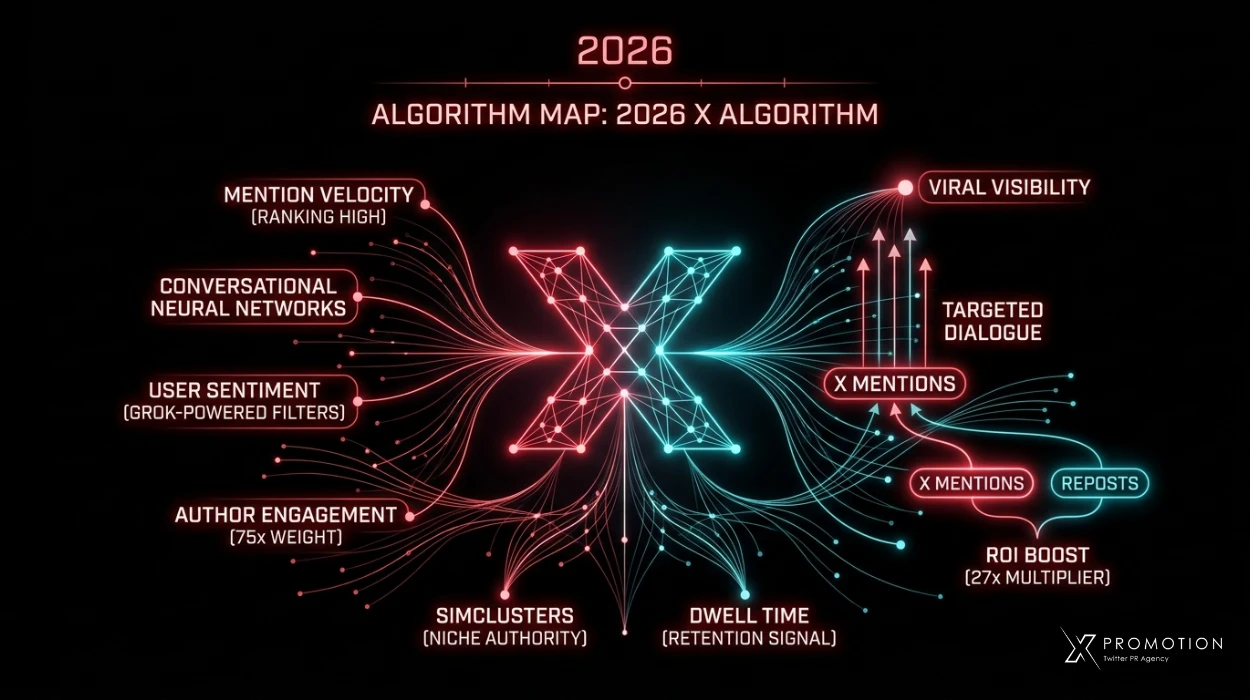
The architecture of the X (Twitter) algorithm underwent its most radical transformation in early 2026. Following the full open-sourcing of the recommendation engine, we now have definitive proof that the platform has transitioned from a simple “Engagement Counter” to a “Conversational Neural Network.” In this new era, the system doesn’t just ask if people liked your post; it measures the depth of the dialogue surrounding it. At the center of this dialogue-first approach is the metric of X Mentions.
The 2026 Interaction Weight System
To rank your content in 2026, you must understand the numerical values assigned to user actions. Recent leaks from the GitHub repository of the X recommendation engine reveal that the algorithm uses a “Heavy Ranker” pipeline that scores posts based on probability labels. While a “Like” serves as a baseline (1x), a “Mention” or a “Reply” triggered by your content carries significantly higher mathematical weight.
Algorithmic Multipliers (Relative to Likes)
Infographic showing the 75x boost given to conversation threads where the author replies to a mention.
How Mentions Define Your Social Graph
X uses a “SimClusters” algorithm to group users into communities (e.g., Tech, Finance, Fashion). When you receive mentions from users within a specific cluster, the algorithm validates your account as a “Source of Truth” for that topic. This isn’t just about reach; it’s about Indexing. By generating a high volume of engagement through conversation, your account is essentially ‘voted’ into the top tier of your niche’s interest graph.
The “Author Engagement” Multiplier
The single most powerful signal in the current algorithm is a “Reply engaged by author.” When someone mentions you and you respond, the system gives that entire thread a massive visibility boost. This is why “Community Management” has become the primary driver for organic growth. If you are consistently referenced in posts, you are building a defensive moat against algorithmic reach decay.
Many creators fail to realize that the quality of these interactions matters. The Grok-powered sentiment analysis now filters for “low-effort” engagement. This is why sophisticated marketers are looking for ways to leverage high-authority mentions over simple retweets to maximize engagement ROI. A retweet increases reach for 24 hours, but a mention-based conversation builds authority that lasts for months.
Technical Ranking Pipeline: How Your Post Moves
Every time a user opens their “For You” feed, the X algorithm executes a three-stage process: Candidate Retrieval, Scoring, and Heuristics. During the scoring phase, the “Grok-Transformer” architecture predicts the probability of a user replying or mentioning the author. If your handle is frequently cited by others, the system identifies you as a core node in the network, bypassing several restrictive diversity filters.
| Feature | 2025 Weight | 2026 Weight | Impact on Visibility |
|---|---|---|---|
| External Links | -30% | -50% | Extreme Suppression |
| Native Video | +2x | +4x | Massive Push |
| Targeted Dialogue | +15x | +27x | Highest Authority Signal |
Strategies for Mentions-Based SEO
Because X now behaves like a real-time search engine, you must treat your handle as a keyword. When others mention you, they are essentially providing “backlinks” within the X ecosystem. To optimize for this, focus on generating “Mention-Bait” content. Ask questions that require people to tag others or mention your expertise. Also, ensure you respond to mentions within the first 30 minutes, as engagement received in this window is weighted significantly higher by the ranking pipeline.
As the platform continues to prioritize real-time news and behavioral data, the density of your conversational network will be the only metric that matters. Whether you are a brand or a solo creator, your goal in 2026 is to move from being a broadcaster to being a dialogue hub. By focusing on generating consistent dialogue, you ensure that the algorithm always has a reason to surface your content to the top of the “For You” feed.