
Thought leadership on X is built through the consistent development of authority signals, audience trust, and content relevance within a defined subject area. Effective thought leadership development depends on the interaction between content distribution, engagement quality, visibility indicators, and profile authority.
X growth strategies differ based on how they generate audience reach, engagement signals, and authority recognition across the platform.
X audience development methods are evaluated through audience quality, growth velocity, retention performance, and long-term visibility outcomes.
Content amplification approaches on X are measured through distribution efficiency, network effects, engagement quality, and sustainability.
Organic growth strategies prioritise authority development through content relevance and audience trust, while amplification-focused approaches prioritise accelerated content distribution.
Organic growth is the process of attracting audiences through consistent publication, engagement participation, and expertise demonstration. X operates by identifying behavioural patterns that indicate content relevance and audience interest. Organic approaches generate visibility through repeated engagement signals and audience interactions. Audience growth velocity develops gradually because authority indicators strengthen over time. This model creates high audience relevance because followers engage with a clearly defined topic ecosystem.
Amplification-focused approaches increase content exposure by expanding distribution opportunities. Content amplification refers to the process of extending visibility beyond immediate audience networks. X distributes amplified content through repost activity, discussion participation, recommendation systems, and network effects. Audience growth velocity often increases more rapidly because content enters additional visibility pathways. However, distribution scale does not automatically create authority recognition.
When evaluating effectiveness, organic growth demonstrates stronger sustainability and audience retention. Amplification-focused methods demonstrate stronger short-term reach and content distribution efficiency. Organic growth requires greater time investment, while amplification-focused approaches require greater distribution activity. The comparison highlights a distinction between authority accumulation and visibility expansion.
Content-led growth prioritises information value, while engagement-led growth prioritises interaction generation.
Content-led growth is a framework where audience development originates from publishing expertise-driven information. X is an information distribution network that evaluates content relevance through engagement signals and audience behaviour. Content-led approaches focus on analytical posts, educational insights, industry observations, and knowledge dissemination. Visibility develops when audiences repeatedly engage with valuable information. Authority indicators strengthen because expertise becomes associated with profile identity.
Engagement-led growth focuses on conversations, replies, discussions, and interaction frequency. X operates by recognising engagement patterns that indicate active participation within communities. Profiles using engagement-led methods increase visibility through direct audience interaction. This model expands network exposure because conversations generate additional discovery opportunities.
Content-led growth demonstrates stronger thought leadership signals because expertise remains central to audience perception. Engagement-led growth demonstrates stronger relationship-building capabilities because audience interaction frequency increases. Content-led strategies require greater information production resources, while engagement-led approaches require greater participation resources. The comparison illustrates how authority formation and network expansion operate through different mechanisms.
Audience quality is influenced more significantly by retention strategies, while audience scale is influenced more directly by acquisition strategies.
Audience acquisition strategies focus on attracting new followers through content distribution, profile visibility, and discovery mechanisms. X distributes content through recommendation systems, search visibility, repost activity, and conversation participation. Acquisition frameworks measure performance through audience growth velocity and reach expansion. Visibility indicators play a central role because audience discovery precedes audience conversion.
Audience retention strategies focus on maintaining existing audience engagement and relationship continuity. Retention is the process of sustaining relevance among established followers. X evaluates ongoing audience interaction through repeated engagement patterns. Profiles with strong retention metrics generate consistent engagement quality because audience familiarity strengthens trust and participation.
Acquisition approaches produce larger audience expansion opportunities. Retention approaches produce stronger audience relevance and engagement consistency. Acquisition prioritises scale, while retention prioritises relationship depth. The most sustainable thought leadership models depend on retention because authority indicators strengthen through repeated audience interactions rather than isolated discovery events.
Authority-building methods strengthen credibility, while visibility-focused tactics strengthen exposure.
Authority-building is the process of establishing recognised expertise within a topic ecosystem. Authority indicators include analytical content, expertise consistency, engagement quality, and subject relevance. X operates by associating profiles with recurring topical patterns. When content consistently addresses a defined area of knowledge, authority recognition becomes easier for both audiences and platform systems.
Visibility-focused tactics prioritise exposure frequency and content reach. Visibility refers to the likelihood that content appears within feeds, recommendations, discussions, and search environments. These tactics increase content impressions and audience encounters. Exposure volume expands because content enters more distribution channels.
Authority-building demonstrates stronger long-term sustainability because trust accumulates over time. Visibility-focused tactics demonstrate stronger short-term distribution performance because exposure occurs immediately. Authority contributes directly to audience trust and engagement quality. Visibility contributes directly to audience reach and discovery opportunities. The evaluation reveals that visibility creates awareness while authority creates recognition.
The strongest authority signals originate from expertise consistency and engagement relevance.
These signals contribute more effectively to thought leadership development than exposure metrics alone because they strengthen audience perception.
Thought leadership approaches prioritise expertise communication, while promotional content strategies prioritise message visibility.
Thought leadership is the communication of insights, analysis, and informed perspectives. X operates by distributing content that generates engagement relevance and audience participation. Thought leadership approaches develop profile authority because information value remains central to content production. Audience trust increases as expertise signals become more visible over time.
Promotional content strategies focus on awareness generation and message exposure. Visibility indicators often increase because content is designed for broader distribution opportunities. However, promotional content frequently relies on attention acquisition rather than authority development. Audience interaction patterns therefore differ from expertise-driven engagement.
Thought leadership demonstrates stronger audience quality because followers associate content with knowledge and relevance. Promotional strategies demonstrate stronger awareness generation because exposure frequency remains a priority. Thought leadership strengthens authority indicators, while promotional approaches strengthen visibility indicators. The distinction explains why expertise-driven growth often generates more sustainable audience engagement patterns.
X distributes content through engagement signals, relevance evaluation, and network-based recommendation systems.
Content distribution refers to the process through which information reaches audience segments across the platform. X evaluates user behaviour to determine content relevance. Engagement signals such as replies, reposts, dwell time, and profile interactions contribute to visibility decisions. Distribution pathways expand when content demonstrates audience relevance within specific topic environments.
Network effects play a significant role in audience expansion. A single interaction introduces content to additional visibility opportunities through follower networks and discussion threads. Recommendation systems identify behavioural similarities between users and increase content exposure among related audience groups. This process strengthens content distribution efficiency because relevance determines exposure allocation.
Profiles pursuing thought leadership benefit from distribution systems when engagement quality aligns with topical relevance. Content that generates meaningful discussion often receives stronger visibility outcomes than content that generates passive interaction. Distribution therefore depends on both audience behaviour and content value.
Engagement signals influence thought leadership growth by validating content relevance and strengthening distribution opportunities.
Engagement signals are measurable audience actions that indicate interest, participation, or content value. X is a behavioural evaluation system that uses these signals to inform distribution decisions. Replies indicate active discussion participation, while reposts indicate content amplification. Profile visits indicate audience curiosity, and follows indicate sustained interest.
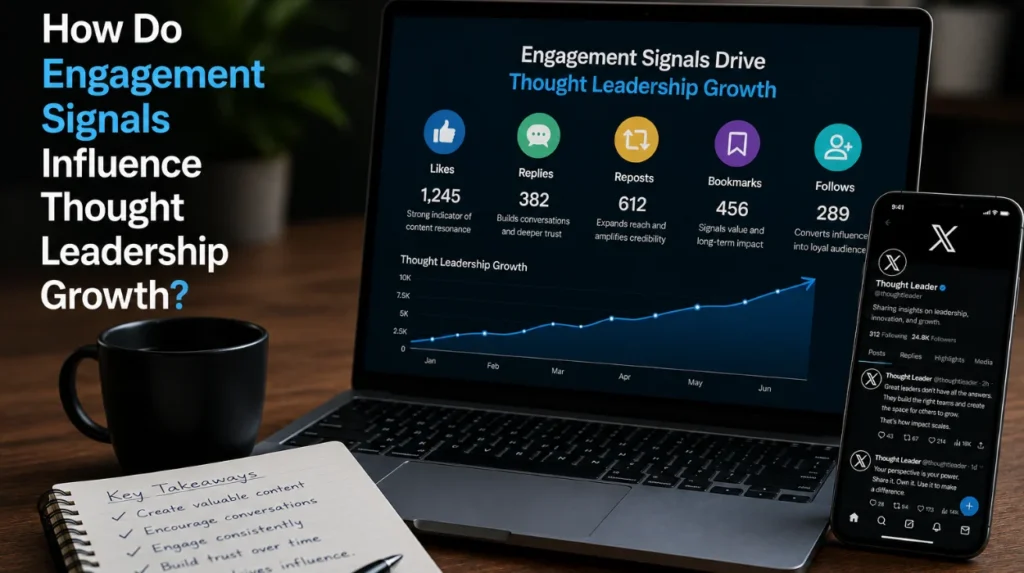
Thought leadership development relies heavily on engagement quality rather than interaction volume alone. A smaller number of topic-relevant discussions generates stronger authority indicators than broad engagement disconnected from expertise areas. This distinction influences audience trust because relevance reinforces credibility.
Engagement quality also affects audience retention. Users who repeatedly participate in topic-specific discussions contribute to stronger community formation. These interactions improve audience loyalty and strengthen profile authority. As engagement quality increases, visibility opportunities often increase because content relevance becomes more apparent.
Short-term visibility gains improve exposure, while long-term audience development improves authority and sustainability.
Short-term visibility gains focus on immediate reach expansion. X distributes content rapidly when engagement velocity increases within a limited time frame. Visibility indicators rise because exposure frequency expands across recommendation environments and discussion networks. These gains are effective for audience discovery and content reach measurement.
Long-term audience development focuses on relationship continuity, trust accumulation, and authority growth. Audience development is the process of creating ongoing engagement between profiles and followers. Engagement quality becomes more consistent because audience expectations align with content relevance. Authority indicators strengthen through repeated interactions and expertise recognition.
Short-term visibility demonstrates stronger immediate distribution impact. Long-term audience development demonstrates stronger sustainability, retention performance, and thought leadership outcomes. Visibility generates attention, while audience development generates recognition. Profiles pursuing thought leadership benefit more substantially from long-term authority accumulation because trust functions as a durable growth asset.
Thought leadership development is evaluated through authority indicators, engagement quality, audience relevance, and visibility sustainability.
A structured evaluation framework helps compare growth approaches objectively:
This framework demonstrates that thought leadership performance extends beyond follower counts. Authority, trust, engagement quality, and distribution efficiency provide a more accurate representation of influence development within the X ecosystem. The broader evaluation process often intersects with discussions surrounding X thought leadership building service, particularly when analysing structured approaches to authority development and audience growth systems.
Building thought leadership on X involves evaluating multiple growth approaches rather than relying on a single visibility strategy. Organic growth and authority-building methods prioritise audience trust and sustainability, while amplification-focused and visibility-oriented approaches prioritise reach expansion and exposure.
Content-led growth strengthens expertise recognition, whereas engagement-led growth strengthens network participation. Audience acquisition expands reach, while audience retention improves audience quality and long-term engagement consistency. Thought leadership approaches focus on authority indicators and expertise signals, whereas promotional strategies focus on awareness generation and visibility outcomes.
The comparison of these methods demonstrates that thought leadership development depends on the interaction between content distribution efficiency, engagement quality, authority recognition, and audience retention. Understanding these relationships provides a clearer framework for evaluating profile growth, visibility performance, and long-term audience development within the X ecosystem.