
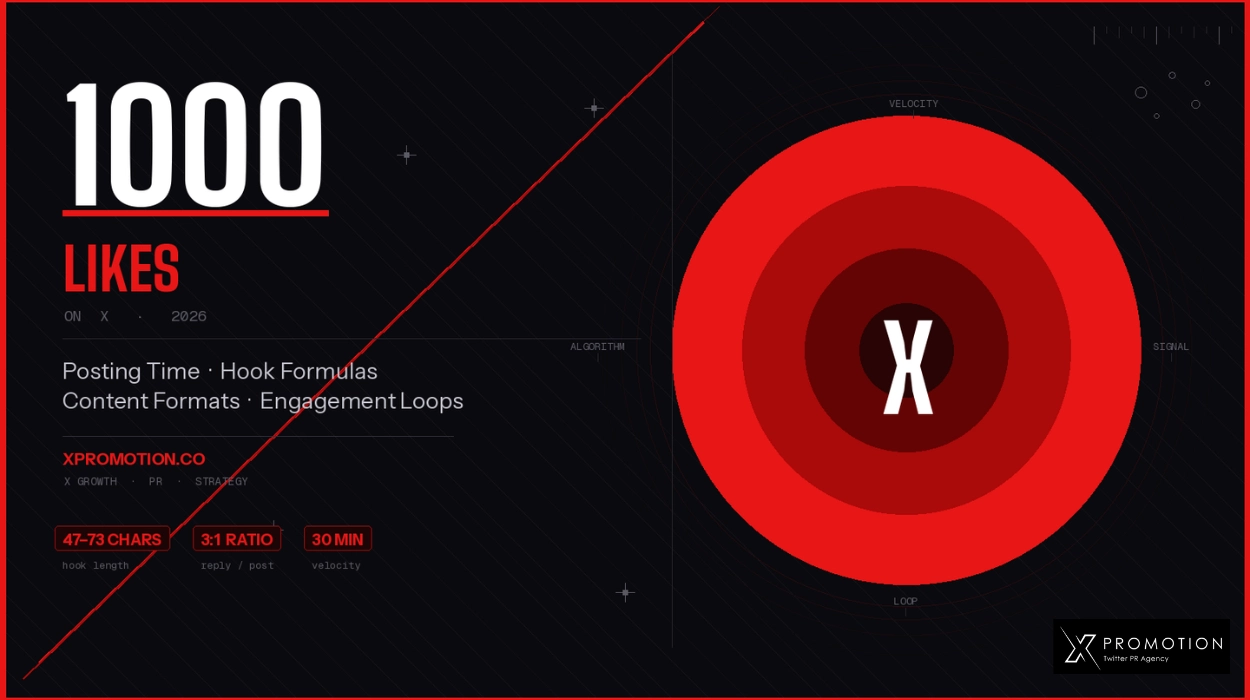
Most accounts that fail to reach 1000 likes are not posting bad content. They are making three fixable process mistakes: wrong hook length, wrong posting time, and no engagement activity before or after publishing. This guide fixes all three, using tested data from growth experiments and community-sourced research across X, Reddit, and Quora in 2025 and 2026.
The Real Reason You Are Stuck Below 1000 Likes
One of the most searched questions on Quora and Reddit from X users is some version of: “I post every day but get almost no likes. What am I doing wrong?” The answer is almost never the content itself. It is the system around the content.
X’s algorithm treats your first 30 minutes as an audition. It shows your post to a small test pool, mostly your existing followers, and measures whether they engage or scroll past. If your like-to-impression ratio is strong, the algorithm expands distribution to adjacent interest clusters. If it is weak, the post quietly dies regardless of how good the idea was.
The accounts that reach 1000 likes first are not the most talented writers on the platform. They are the ones who have learned to consistently pass that 30-minute audition, post after post, until the algorithm builds enough confidence in their content to start doing the heavy lifting for them.
Before going into specific tactics, it is worth understanding the foundational mechanics at play. The detailed breakdown of how X likes function as algorithmic signals in 2026 explains exactly why each like you earn compounds into future reach in ways most creators overlook.
The 47-73 Character Hook Rule (And Why It Works)
This is not a made-up guideline. It comes from tested analysis of hook performance across hundreds of accounts in 2025. Hooks in the 47 to 73 character range consistently outperform both shorter and longer first lines in like rate. Here is why each boundary matters:
On mobile, which is where most X users read content, the first line of a post is often cut at around 70 to 80 characters before a “Show more” break appears. Your hook must complete its emotional impact inside that window. If the reader has to tap “Show more” before they understand what the post is about, most will not tap.
Six hook formulas that consistently produce likes
Disrupts an assumption. The reader must resolve the contradiction by reading on. Earns likes from readers who have had the same experience.
Specificity signals real experience. A specific number is more credible than a round one. Primes the reader to expect concrete value.
Earned authority in the first sentence. The reader believes the writer before the claim is even made.
Calls out a behavior the reader likely recognizes in themselves. Agreement is instant. The like follows the recognition.
Creates a question the reader needs answered. Curiosity is one of the strongest sustained engagement drivers on any platform.
Stakes a clear position. Strong agreement earns likes. Strong disagreement earns replies. Both signals improve distribution.
The 40-30-20-10 Content Mix That Actually Gets Liked
One of the clearest patterns observed across growing X accounts in 2026 is a consistent content ratio. Accounts that struggle tend to invert it, posting mostly promotional or self-focused content. Accounts that grow quickly maintain a disciplined split:
Four-card grid showing the 40-30-20-10 content mix breakdown for X growth in 2026, with percentages and content type descriptions.
Why proof-based content is the most underused format
Posting proof, meaning actual screenshots of analytics, real revenue numbers, or concrete before-and-after results, is consistently the most shared and saved content type on X in 2026. It is also the format most creators avoid because it feels vulnerable. That vulnerability is exactly why it earns strong engagement. Anyone can make a claim. Showing real data behind it triggers both trust and the like response in readers who recognize the effort and honesty.
Why opinion posts cannot be your entire strategy
Opinion posts earn the highest like rate per post but produce diminishing returns when they become your default format. An account that posts nothing but hot takes trains its audience to expect friction, not value. When the same audience sees an educational or story post, it feels surprising and fresh, which earns higher engagement than if that same post had been posted by a mixed-content account. Variety is a like-rate strategy, not just a content preference.
Posting Time: The Windows That Maximize Early Like Velocity
The first 30 minutes after publishing are when the algorithm decides your post’s distribution ceiling. Posting when the largest portion of your target audience is active online is not optional. It is the difference between passing and failing that 30-minute audition.
How to find your personal peak window in 30 days
- Rotate across the four windows for 30 days. Post comparable content types at each window across separate weeks. Keep the content format consistent so timing is the only variable changing.
- Check X Analytics 48 hours after each post. Record likes earned in the first hour specifically. This is the metric that reveals your actual peak window, not total likes over 7 days.
- Identify your two best-performing windows. Most accounts have one strong weekday morning window and one strong evening window. Both are worth using.
- Lock in and repeat for 60 days. Consistency trains both the algorithm and your audience to expect your content at the same time, increasing the probability of fast early engagement.
The 3:1 Reply Ratio: The Engagement Loop That Compounds Likes
The 3:1 reply ratio is one of the most referenced tactics in active growth hacking communities covering X in 2025 and 2026. The principle is simple: for every original post you publish, leave three substantive replies on popular posts in your niche. Here is why it works mechanically:
Reply earns impressions
A reply on a post with 50,000 impressions can earn 5,000 to 15,000 views. That puts your name in front of exactly the audience most likely to engage with your next post.
Profile visits convert to likes
Users who find a reply compelling visit your profile. If your pinned post or latest post is strong, those visits convert to likes on your existing content within minutes.
Algorithm reads the signal chain
When profile visits and likes cluster in the 15 minutes before your next post, the algorithm treats your upcoming post as coming from an active, engaged account, expanding its initial test pool.
Reply threads compound over time
A good reply from three weeks ago can continue driving profile visits today. Unlike posts, which decay quickly, quality replies on popular threads stay visible as long as the thread remains active.
Relationship signal builds trust
Consistently engaging with accounts in your niche signals community membership to the algorithm. This is one of the factors that determines which Topics your content gets placed in.
Quote-tweet amplification
Quote-tweeting your own post 4 to 6 hours after publishing with a fresh angle or a hotter take has been documented to roughly double reach on posts that initially performed moderately well.
The post-publish window: 20 minutes that change everything
Replying to every comment your post receives within 20 minutes serves two functions simultaneously. It signals to the algorithm that your post is producing active engagement, not passive consumption. And it brings commenters back to the thread, where they often like the original post again, share it, or show it to their own followers. This secondary engagement wave is how posts continue accumulating likes for hours after the initial publishing window.
What Threads Still Do and Do Not Do in 2026
Thread strategy has changed significantly since 2023. The 20-post mega-thread model that dominated creator feeds two years ago is largely dead. What works now is different in structure and intent.
| Thread Type | 2023 Status | 2026 Status | Like Behavior |
|---|---|---|---|
| 20+ post mega-thread | High reach | Mostly dead | Engagement drops after post 4 regardless of quality |
| 3 to 6 post tight thread | Moderate | High performer | Each post can earn independent likes; compounds total |
| Screenshot or proof thread | Low use | High performer | Visual posts earn more feed real estate, more impressions |
| Quote-tweet thread | Moderate | Growing | Self-quote 4 to 6 hours later can double total reach |
| Single standout post | Moderate | Consistently strong | Highest like rate per unit of content when hook is sharp |
The key takeaway from community research in 2025 is that short threads with real proof, screenshots of data, actual results, or genuine process documentation, consistently outperform threads built entirely on text-based opinions or advice. Proof is the most shareable content format on X right now, and it works especially well as the visual anchor in a tight 3 to 5 post thread.
Mistakes That Actively Kill Your Like Growth
These are not edge cases. They are patterns documented consistently across stalled accounts in forums, community discussions, and growth audits in 2025 and 2026:
- Hook is under 30 characters or over 90 characters
- Publishing at random times with no pattern
- Ignoring comments in the first 20 minutes after posting
- Switching niches before the algorithm has built your content profile
- Using more than two hashtags per post
- Starting posts with “I wanted to share” or “Today I learned”
- Posting 80 percent promotional content and 20 percent value
- Deleting underperforming posts instead of learning from them
- Writing for a general audience instead of a specific one
The hashtag point deserves a note: X’s algorithm in 2026 uses semantic analysis to determine topic relevance. More than two hashtags is now consistently associated with lower distribution, not higher, because the algorithm flags heavy hashtag use as low-quality or spammy content. One niche hashtag and one broader topical hashtag is the current practical maximum.
Community threads across growth hacking discussions confirm that consistent process discipline matters more than content brilliance in the first 60 days of trying to grow on X. The best hook in the world posted at the wrong time with no pre-warm engagement activity will underperform a decent hook posted at peak time after 15 minutes of niche engagement.
Services That Accelerate the Path to 1000 Likes
The organic tactics in this guide work. They also require daily discipline and 30 to 45 minutes of consistent effort. For creators and brands who want to compress that timeline or maintain output quality at scale, the following XPromotion PR services are built to complement each phase of the strategy covered here:
X Copywriting and Thread Writing
Professional hook writing and thread structure built around the formats and formulas that consistently earn the highest like rates. Every post leaves the draft phase already optimized for engagement.
View service →X Content Strategy and Calendar
A structured 30 or 90-day content calendar that builds the 40-30-20-10 content mix into a posting schedule, removing the daily decision fatigue that causes most accounts to post inconsistently.
View service →X Analytics and Reporting
Clear data on which posts earned the most likes, when your personal peak window falls, and what the algorithm’s content profile for your account currently looks like. The intelligence layer behind the strategy.
View service →Influence Network Building on X
Building genuine connections with relevant accounts in your niche accelerates the 3:1 reply ratio strategy by creating relationships that make early likes more predictable and consistent from post one.
View service →If you want a complete picture of the organic strategy that underpins these services, the full guide on getting more likes on X with algorithm-backed tactics in 2026 covers the broader strategic framework across every account type.
Your first 1000 likes on X is a systems problem, not a talent problem. The accounts that reach it fastest are not the ones with the sharpest ideas. They are the ones writing hooks between 47 and 73 characters, posting at the right time in their audience’s day, spending 15 minutes warming up the engagement environment before they publish, and replying to every comment within 20 minutes after. Do that with the 40-30-20-10 content mix, consistently, for 60 days, and the algorithm stops being an obstacle and starts being an engine.
Ready to Hit Your First 1000 Likes on X?
XPromotion PR offers X likes services, content strategy, copywriting, and full growth packages built for creators, brands, and executives who need measurable results on X.
Explore X Likes Services →