
X Premium ROI for PR departments is evaluated through visibility efficiency, audience reach expansion, authority development, engagement quality, and content distribution performance rather than direct subscription cost alone.
X growth strategies differ based on how profiles generate visibility, strengthen authority indicators, and expand audience reach within platform distribution systems. X audience development methods are evaluated through engagement quality, audience retention, content amplification efficiency, and long-term influence creation. Content amplification approaches on X are measured through distribution velocity, network effects, profile authority signals, and sustained audience interaction patterns.
X Premium and organic growth strategies operate through different mechanisms that influence audience reach and content visibility.
Organic growth is audience expansion generated through consistent content publication, engagement activity, community participation, and profile authority development. Growth occurs when content repeatedly earns engagement signals that trigger wider distribution across feeds, recommendations, and search surfaces. Organic approaches rely heavily on content relevance and audience interaction quality.
X Premium operates by adding platform-level features that affect publishing capabilities, profile presentation, and content interaction opportunities. The subscription layer becomes part of the visibility ecosystem but does not replace audience-driven engagement mechanisms. Distribution still depends on relevance signals and interaction behaviour.
From an effectiveness perspective, organic growth produces stronger audience alignment because followers are acquired through demonstrated interest in content topics. Audience quality therefore tends to remain stable over extended periods. Growth velocity, however, is constrained by content production consistency and audience discovery limitations.
Premium-enhanced participation increases publishing flexibility and profile visibility indicators. Visibility opportunities expand, but sustained audience development remains dependent on content performance. Organic growth demonstrates stronger sustainability, while Premium participation increases operational efficiency within existing distribution systems.
Content-led growth and engagement-led growth influence visibility through distinct audience development pathways.
Content-led growth is a framework where information quality, educational value, topical relevance, and publication consistency drive audience expansion. X operates by distributing content that generates interaction signals, making content quality a central factor in long-term reach development.
Engagement-led growth prioritises direct interaction through replies, conversations, discussion participation, and network engagement. Instead of relying primarily on published content, visibility is generated through relationship-building activities across the platform ecosystem.
Content-led approaches scale efficiently because individual posts continue generating visibility after publication. Evergreen educational content, analytical commentary, and industry-focused insights contribute to recurring audience discovery. Resource requirements concentrate on research, production, and publication.
Engagement-led methods create stronger audience relationships because interactions occur directly within conversations. Engagement quality frequently exceeds passive content consumption. Scalability remains lower because audience expansion depends on continuous participation and interaction activity.
Comparative evaluation shows content-led growth improving distribution efficiency, while engagement-led growth strengthens audience connection and retention. Profiles combining both approaches typically establish stronger authority indicators across multiple visibility channels.
Audience retention strategies generate higher long-term efficiency, while audience acquisition strategies produce broader reach expansion.
Audience acquisition refers to attracting new followers through visibility, discovery mechanisms, content distribution, and engagement opportunities. Growth metrics focus on reach expansion, follower increases, and exposure across audience segments.
Audience retention refers to maintaining existing audience engagement through consistent value delivery, relationship development, and authority reinforcement. Retention metrics focus on engagement consistency, audience loyalty, profile interaction frequency, and content consumption behaviour.
Acquisition strategies increase visibility rapidly because platform algorithms continuously expose content to new users. Reach expansion strengthens awareness and creates opportunities for audience growth velocity. Resource requirements remain high because continuous discovery activity is necessary.
Retention strategies improve engagement quality because existing audiences interact more consistently with recognised content sources. Strong retention increases content distribution performance by generating recurring engagement signals. Distribution efficiency therefore improves over time.
PR departments evaluating ROI frequently analyse both metrics simultaneously because acquisition expands potential reach while retention strengthens authority and engagement stability. Sustainable profile development requires balance between audience expansion and audience maintenance.
Authority-building methods prioritise trust development, while visibility-focused tactics prioritise audience exposure.
Authority is perceived expertise, credibility, and reliability within a specific subject area. Authority indicators emerge through consistent content publication, audience recognition, engagement quality, and topical relevance. X distributes authority through recurring interactions that reinforce audience trust.
Visibility-focused tactics aim to maximise exposure through distribution opportunities, engagement activity, content timing, and network participation. The objective is broader reach rather than expertise reinforcement.
Authority-building approaches generate stronger audience trust because information quality remains central to profile development. Trust increases interaction quality and strengthens long-term engagement signals. Authority also improves audience retention because followers associate the profile with reliable information.
Visibility-focused approaches increase exposure efficiently. Content reaches larger audiences within shorter timeframes, improving discovery potential. Limitations emerge when exposure exceeds authority development because audience retention rates often decline.
Evaluating both frameworks reveals that visibility creates opportunities for audience acquisition, while authority converts exposure into lasting audience relationships. Authority therefore demonstrates stronger sustainability, whereas visibility produces stronger short-term distribution outcomes.
Thought leadership approaches strengthen authority indicators, while promotional content strategies prioritise message exposure.
Thought leadership is the systematic publication of expertise-driven information that establishes topical authority. X operates by associating profiles with recurring subject matter, allowing audiences to recognise expertise through repeated interaction patterns.
Promotional content focuses on awareness generation through announcements, updates, campaigns, and visibility-oriented messaging. Distribution depends heavily on audience attention rather than expertise development.
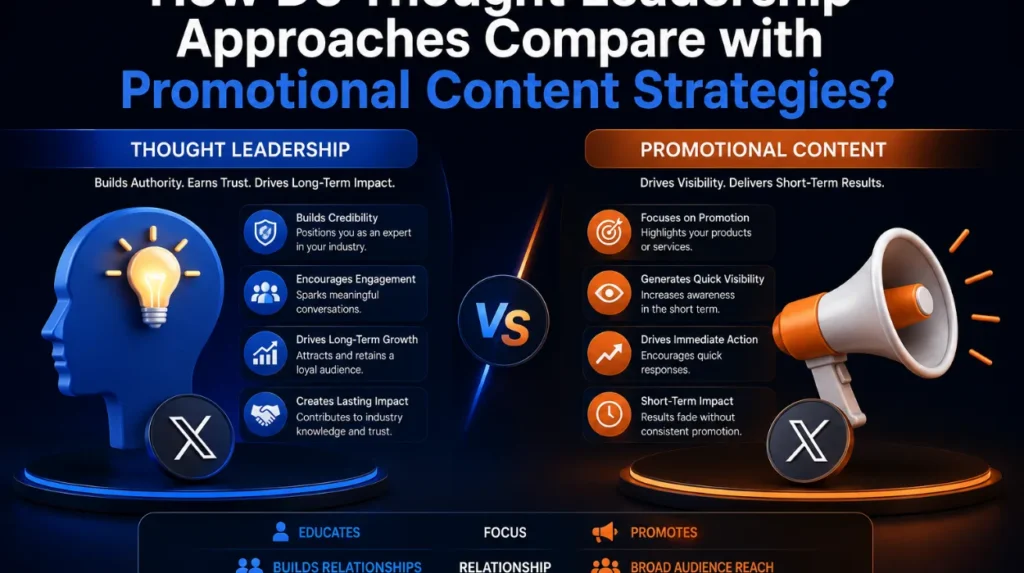
Thought leadership improves audience trust because content consistently demonstrates knowledge depth and analytical capability. Engagement quality often increases because audiences participate in discussions related to expertise and industry insights. Authority signals strengthen progressively through repeated interactions.
Promotional content generates immediate visibility but typically experiences shorter engagement cycles. Distribution efficiency often depends on audience familiarity and existing reach rather than informational value.
Comparative analysis demonstrates that thought leadership strengthens profile authority and retention metrics, while promotional strategies increase short-term exposure. Long-term audience growth frequently aligns more closely with authority development than visibility-only communication models.
X Premium influences content distribution efficiency by expanding publishing capabilities and profile-level visibility indicators.
Content distribution efficiency refers to the ability of information to reach relevant audiences through platform recommendation systems, engagement pathways, and network effects. Distribution performance depends on engagement signals, audience interaction quality, and content relevance.
Standard participation relies entirely on core platform functionality. Visibility emerges through content quality, audience relationships, and interaction frequency. Distribution remains dependent on engagement-generated signals.
Premium participation introduces additional publishing opportunities, profile enhancements, and interaction tools. These features expand content presentation options and strengthen profile recognition mechanisms. Distribution opportunities therefore become broader.
The effectiveness difference depends on content performance rather than feature access alone. Premium capabilities improve operational flexibility, while engagement quality remains the primary distribution driver. Profiles generating stronger audience interaction consistently outperform profiles relying solely on platform features.
Long-term audience development produces stronger sustainable outcomes, while short-term visibility gains generate immediate exposure.
Short-term visibility gains focus on maximising reach through distribution opportunities, trending discussions, engagement spikes, and high-frequency activity. Metrics emphasise impressions, exposure, and audience discovery.
Long-term audience development focuses on authority creation, engagement consistency, audience retention, and relationship strengthening. Metrics prioritise interaction quality, recurring engagement, and profile credibility.
Short-term visibility increases awareness rapidly because content enters larger distribution networks. Exposure improves acquisition opportunities and strengthens discovery potential. Sustainability remains limited because visibility frequently declines after engagement activity decreases.
Long-term development creates stronger audience foundations. Authority indicators accumulate, engagement consistency improves, and audience trust increases. Distribution performance benefits from recurring interaction signals generated by established followers.
Evaluation across scalability, sustainability, and audience quality demonstrates stronger long-term value from audience development strategies. Visibility remains important, but sustainable profile growth depends on converting exposure into retained audience relationships.
PR departments evaluate X Premium ROI through performance indicators connected to visibility, engagement, authority, and audience development.
A structured evaluation framework includes:
This framework shifts analysis away from subscription features and towards measurable outcomes within the broader X ecosystem. ROI becomes a function of visibility performance, audience quality, authority development, and distribution effectiveness rather than platform access a
X Premium ROI for PR departments is best understood through comparisons between audience growth approaches, authority-building methods, content distribution frameworks, and engagement strategies.
Organic growth provides sustainability, while Premium participation improves operational flexibility. Content-led approaches enhance distribution efficiency, whereas engagement-led methods strengthen audience relationships. Authority-building strategies improve trust and retention, while visibility-focused tactics expand exposure. Thought leadership reinforces credibility, while promotional approaches prioritise awareness generation.
The most significant strategic consideration is the relationship between visibility and authority. Visibility creates audience discovery opportunities, but authority transforms exposure into long-term engagement. PR departments evaluating X Premium ROI therefore benefit from analysing audience quality, distribution efficiency, engagement consistency, and authority development rather than focusing exclusively on reach metrics.